The Art of Nature and the Nature of Art
  • Musings on Life and Work in Progress
  • Find my gallery
  • Contact Me Directly

Black black

30/5/2016

0 Comments


Until I started to paint, I never gave much thought to how colours were created.  Of course I had my favourites, but I kept running into trouble whenever I tried to put together an wardrobe, if my closet could be dignified with the name.  Inevitably, those two "turquoise" items didn’t match let alone play nicely together, and reds were even worse.  Sometimes I could get away with it by choosing a plaid or a tweed but I doubt that I was the only person lost with no hope of exact colour coordination.  

It wasn't until I began to paint that the penny dropped:  there were simply endless possibilities of colour mixing.  Perhaps the biggest surprise was black.  I had been taught that it was the combination of all colours, but then so was brown.  When I began painting in oil it became clearer that black lacks white, while brown invites it, even if it's just a bit.  But black, the "darkest dark," has an ace in the hole:  its tremendous value when set next to the "lightest light" to highlight a focal point.  Easy peezy.  Black's a star.

But not so fast!  Nobody  I know simply buys a tube of black and uses it indiscriminately.  For one thing,  even there lurk dragons — did you want “lamp” black, “ivory” black, “mars” black or “perylene” black?  Each has a specific use.  More importantly, simply applying black out of the tube is a recipe for fatal boredom.  The best paintings contain dancing moody blacks.  What that means is that while the three transparent primaries certainly can produce a perfectly balanced telephone black, it’s much more interesting to tweak the mix so that one or two of them dominate in a way that complements the surrounding elements.  

This is what’s known as “chromatic black.”  For example, I have a weakness for dark backgrounds in botanical painting;  they pop the main attraction forward because most flowers are on the bright side. But I am slowly learning to toggle the chroma accordingly.  Daffodils now ask me for a purple-black to nestle in, red roses like a green-black, while marigolds positively sashay though blue-black.  At times I will mix an ultramarine blue with burnt sienna for warm dark; using phlalo blue and burnt umber produces a cooler dark.  There are as many recipes for deep darks as there are good cooks.

The painter John Anderson uses the term “flavour” to describe his chromatic approach to painting.  You will never find a pure white in a work of his; that bright section might have a tinge of blue or cream. And even in a night scene, his darkest darks, probably tree trunks,  may turn out to be purple, although they will read as black to the casual viewer.  

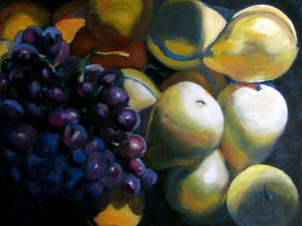
You will also find some flavours in my painting below;  as usual, the blacks are built from many layers of transparent pigments, but they do vary substantially.  So now you have some homework.  Go to www.google.com/culturalinstitute/project/art-project    and mosey through it, looking for paintings with black backgrounds.  Choose one and expand it until you can see the brushstrokes.  What read at first as black will reveal itself to be a varying mixture and one, moreover, which will have a definite “flavour.”  Enjoy! 

Small admission:  yes, I still have trouble finding exact matches in my closet. But it all else fails at least now I can mix the colours I want and dress a self portrait in sartorial splendor!  For that matter, I guess I could be taller too....

Sidenote:   I love the name of Swarthmore College because it reminds me of an old friend who took delight in telling people that she did her undergraduate work at "Black black."
Picture
"Pears and Grapes" glaze oil 12x16
0 Comments

Ebony and Cobalt

25/5/2016

0 Comments

 
  Lately I’ve had the night scene bug.  Those of you who know that I avoid going out after dark might be surprised by this, but there you have it.  Some of my favourite painters capture that moment just after sunset, when there is still a glow at the horizon but little colour left elsewhere.  Naturally, I have tried to take such a picture but I’m too lazy to carry and set up a tripod and  our house does not address the west.  As a result, my “Night Scenes” iPhoto event has fewer than a dozen examples, half of which are blurred past any useful stage.  What to do?

I suppose that if I understood the basic principles of painting a night scene, I might be able to transform a scene, so I have been sitting here and looking at the masters, ancient and contemporary, of this art.  Who’s the best?

Well, Edward Hopper is unequalled at his graphic depictions of often solitary city people glimpsed through cafe windows late at night, probably during The Depression;  Hopper’s warm palette of clean primaries makes me happy, although often guiltily, given the stark loneliness he portrays.   Watch for his ledges, where the light spills out.  Two other Americans, Linden Frederick and John F. Carlson, accomplish the same objective by painting farmyards empty even of animals.  Their work is haunting in its simplicity.

The modern city, on the other hand, seems almost festive.  Hsin Yao Tseng, a precocious child of thirty, paints symphonies of lights, often reflected on wet pavement.  So too Jeremy Mann’s cities look intimate and beautiful, studded with the rubied tail lights;  he is an elderly 37.    Note to Self:  go downtown with a tripod.  Perhaps a camera too.  Find a teenager to run into traffic and set up.  Start thirty years ago.

My only blinding insight in addition is that they all paint the night sky in a significantly lower value than buildings and trees.  Not much to go on, but a start.  Getting old, Harry.

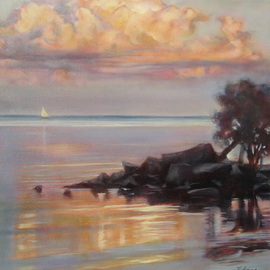
The painting here arose from a lakeshore scene at the beginning of sunset.  The greens have disappeared but light still fills the sky and water. Too early.  What I am craving right now is that breathless moment when the world glows cobalt just after the sun sets. The one I posted last December was on the right track but I ruined it.

 I guess if I hope ever to reflect that deep blue loveliness on the canvas, I should make a point of remembering to go outside and simply TAKING A GOOD LOOK. That approach worked out all right for Tom Thomson, don't you think?

Picture
"Sunset on the Lakeshore" glaze oil 20 x 24
0 Comments

Oops

19/5/2016

0 Comments

 
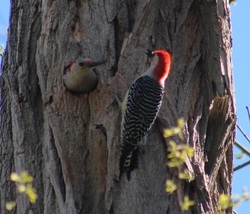
Picture"Honey, I'm home!!"
I humbly and sincerely retract my criticism of hot avian dudes last week.  I knew I was wrong, but advancing the argument trumped my field biology.  And the events of this week have rubbed my nose in it.
Where to start?  Well, R.B. (who wouldn’t use initials when your given name is “Red-Bellied”?) has been heard so often that we began to pay closer to attention to him and made a wonderful discovery.  Jon’s sharp eyes caught him fifty feet up on one of those geriatric black locust trees, only to see R.B. disappear.  A closer look revealed a small hole and - abracadabra - a cavity nest!!  Well, that explained why I could never spot him even though I had heard his four distinct raspy quonks immediately before: he was saying “Honey, I’m home!”  

So now I am developing a permanent kink in my neck from reclining under said tree, focusing my long lens on that exciting front door.  Doesn’t it turn out that R.B. is not only a faithful husband, but an excellent provider as well.  Mr and Mrs take turns in the cavity but the nestlings must be old enough to leave, because often both parents are gone at once.  They return within a few minutes with something juicy, alive and dark — a chrysalis, perhaps -  and about as big as their beaks can manage.  I feel like a proud granny.

Would you please extend my apologies to Mr. Chickadee, Mr. Tanager and Mr. Oriole as well.  In my house, the standard apology (always delivered under duress)  is “I am a stunned pickle.  You were right and I was wrong.  I will never doubt your word again.”  Consider it said, fellas. 

By way of making amends, here is a photo of a happy marriage:

0 Comments

Dudes and Mensches

13/5/2016

0 Comments

 
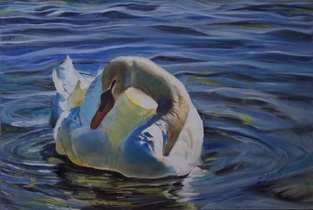
Picture"Rhapsody in Blue" #3 glaze oil 12 x 16
 I have a bit of a crush on a red-head who’s living on our street.  He dresses beautifully in greys and blacks.  Sometimes he drops by for a bite to eat;  sometimes he just hangs around.  I think he’s high most of the time.  We try to ignore one another:  I pretend to be weeding and he pretends to be digging larvae out of our post-mature (i.e. dying) 90 foot black locust trees.  But there’s no avoiding it:  he KNOWS he's the best-looking woodpecker I have ever seen and I live in hope that he’s noticed me too.  His downy and hairy cousins, more frequent visitors to the peanut holder, are nice but seem a little ragged by comparison because boy, he’s SMOOTH.  I find myself wandering out to the garden on any excuse in hopes of catching a glimpse of him.  I even love his croaky voice.

I grant you that this time of the year feathered dudes are pretty gorgeous in general.  While their mates hunker down on nests and try to fade into the woodwork, these snazzy husbands flaunt fluorescents and ratchet up the volume.  They are so busy being gorgeous and assertive that they won’t even pose for a photo op.  The saucy red epaulets of the ubiquitous blackbird continue to elude my camera even though his raucous calls make him impossible to ignore, while Mister Canary’s pure azo yellow flashes past just in time to grab a sunflower seed and he’s gone too.  Who's a girl to paint?


But while I am briefly enamoured with these hot dudes, my real love and admiration goes to the mensches of all species.  I was thinking about this last week during a celebration of life for an lifelong friend (our families have been close for a century).  Fred was a self-described Canada goose who mated for life. When Gina, his beloved wife, succumbed to early onset Alzheimer’s, whether he drove, cycled or walked, Fred went to spend the supper hour with her every day for decades.  He was a wonderful man whose character revealed itself not only in intelligence, but in honour.  I know my  anthropomorphic socks are showing and I don't care.  I choose goose.

P.S.  In the absence of a Canada goose painting, I offer a swan whose gender is indeterminate, just as it should be.  Fred, we will miss you.

0 Comments

Mother's Day 1981

4/5/2016

0 Comments

 
Picture
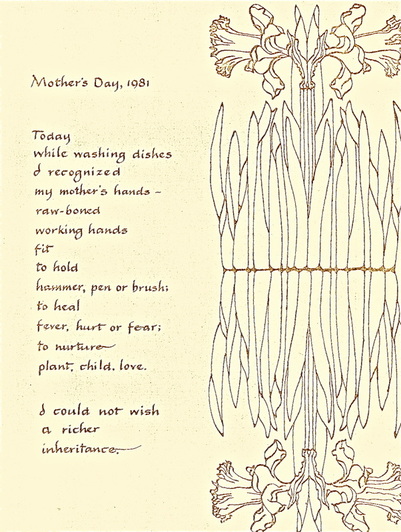
I am looking at my poor, reddened hands with a certain amount of dismay, but also with a small sense of happiness, for I have inherited my mother’s busy hands.  One Mothers’ Day thirty-five years ago I wrote to her about them;   having sketched them that summer I knew them intimately and had suddenly recognized my own hands as faithful copies.


And what was her “hand-work”?  My mother’s skills were myriad;  I think I  learned about the work ethic from her.  Dad went to work each morning and I unfairly took that for granted as a male-thing, but Mom could have chosen to do considerably less with her day.  Instead, she took on sundry tasks:  she preserved and baked, knitted and embroidered, and kept our house in order like the other mothers. Like them she volunteered  with the church and the city.  But she did far, far more. Surprising things.  I often found her on the ladder painting the house, inside or out, wearing a jaunty head-scarf. Colour was deeply important to her and if that meant repainting a wall or the siding, so be it.  Our house was small but she had decorated it beautifully, filling it with "Swedish modern" (now known as "mid-century teak");  you just had to be careful not to run into the piano in the dark because she, though 5’2,” might have moved it earlier that day.   She painted in acrylics, and she listened to me reading my university essays out loud;  decades later she wrote them herself and I edited them for her.   Always completely herself, Mom gave me a hammer as a shower gift, with a note saying that every woman should have one because she might not be able to find her husband's when she needs to hammer a nail;  I thank her every time I have the urge to hang a painting.  


Ironically, Mom thought I was too hard on my own hands.  I admit that I do far more gardening (weeding) than she ever did (she having had her fill of garden work as a child).  My hands are so rough this week after five or six hours of weeding the damned garlic mustard that they are catching on anything smooth;  when that happens,  I hear her softly chiding me and I briefly resolve to do better.  But the big painting I’m finishing (see the website for the current stage) necessitated a series of brush cleaning episodes and so the soft skin boat definitively sailed.   Painting or gardening with gloves on is no fun at all,  so here we are, Mom.  Sorry. Thanks for so much.  I miss you, especially this weekend.    

I should go find my hammer:  there must be a wall of paintings to rearrange.   And the piano might look fabulous on that other wall...

0 Comments
    Picture

    Archive

    July 2023
    April 2023
    March 2023
    February 2023
    January 2023
    December 2022
    November 2022
    October 2022
    September 2022
    August 2022
    July 2022
    June 2022
    May 2022
    March 2022
    February 2022
    January 2022
    October 2021
    July 2021
    March 2021
    January 2021
    December 2020
    November 2020
    October 2020
    October 2019
    September 2019
    August 2019
    July 2019
    June 2019
    May 2019
    April 2019
    March 2019
    February 2019
    January 2019
    December 2018
    November 2018
    October 2018
    September 2018
    August 2018
    July 2018
    June 2018
    May 2018
    April 2018
    March 2018
    February 2018
    January 2018
    December 2017
    November 2017
    October 2017
    September 2017
    August 2017
    July 2017
    June 2017
    May 2017
    April 2017
    March 2017
    February 2017
    January 2017
    December 2016
    November 2016
    October 2016
    September 2016
    August 2016
    July 2016
    June 2016
    May 2016
    April 2016
    March 2016
    February 2016
    January 2016
    December 2015
    November 2015
    October 2015
    September 2015
    August 2015
    July 2015
    June 2015
    May 2015
    April 2015
    March 2015
    February 2015
    January 2015
    December 2014
    November 2014
    October 2014
    September 2014
    August 2014
    July 2014
    June 2014
    May 2014
    April 2014
    March 2014

    Categories

    All
    ALLA PRIMA PAINTING
    ANIMALS
    ART SHOWS
    BOOK RECOMMENDATIONS
    CHRISTMAS
    COLOUR THEORY
    COMPOSITION
    GARDENING
    GLAZE OIL PAINTING
    HOW SHAPE MATTERS
    INSPIRATION
    OUTDOOR LIFE
    PALETTE
    PHOTOGRAPIC REFS
    PORTRAITS OF CHILDREN
    PORTRAITURE
    SEASONS
    STILL LIFE
    SUBJECT MATTER
    THE FUNCTION OF TITLES
    THE HUMAN COMEDY
    THE ISSUE OF SIZE
    THIS OLD HOUSE
    TREES
    UNDERPAINTING
    YouTubes

    RSS Feed

Powered by Create your own unique website with customizable templates.